Amgalan Chin grew up between Ulan-Ude and Irkutsk, in households where compressed dark tea was a kitchen staple long before it became a collector's market. He started buying his first cakes seriously in 2011, working the back rooms of the Maliandao market in Beijing on visa-run weekends, and has spent the years since narrowing his focus to two things — sheng pu'er from a short list of mountains, and the shu and dark teas that travelled the old Russian–Mongolian caravan routes.
His Chinese-tea work centres on Yunnan, specifically the Bulang (布朗) and Yiwu (易武) areas of Xishuangbanna prefecture. He returns to Menghai county most autumns and keeps a working relationship with two small producers — a family pressing on the slopes below Lǎo Bān Zhāng (老班章) village, and an older maker in Mahei who supplies him with thin, fragrant Yī Wǔ (易武) cakes from gardens above the town. He also drinks and stocks a steady amount of Menghai Tea Factory (勐海茶厂) shu, particularly the 7572 recipe, which he treats as the reference point for anyone learning what a clean, properly fermented shú chá (熟茶) tastes like.
His other home territory is hēi chá (黑茶) — Hunan brick tea, Anhua fú zhuān (茯砖), and the Mongolian-bound dark teas that once moved by camel through Kyakhta. He is unusually patient with these teas. Where many tasters dismiss brick tea as a working drink, Amgalan treats a well-aged qiān liǎng chá (千两茶) the same way he treats a fifteen-year Yiwu — slowly, with attention to the wet leaf and how the liquor changes between the third and seventh infusion.
A session with Amgalan tends to start with paperwork rather than tea. He will ask what you already drink, what you have at home, and what you have been storing — even if you think you have been storing nothing. He keeps notes. Then he brews, usually two teas in parallel: a young sheng beside an aged one from the same mountain, or a factory shu beside a small-batch one, so the difference is in the cup rather than in the description. The wet leaf goes onto a white porcelain lid for you to smell between steeps. He talks about pressing dates, storage humidity, and what the tea was probably like five years ago — not to perform expertise, but because those are the variables that actually matter.
For tea.taxi specifically, Amgalan curates the aged-tea side of the catalogue. The Same-day sample pack draws from his working shelf — 100g portions of teas he is currently drinking himself, rotated every few weeks. If a Bulang sheng has just come into a phase he finds interesting, it goes into the pack. If a shu has flattened out in storage, it comes off. The Gift delivery with hand-written card programme runs through him too: he writes the cards in Russian or English depending on the recipient, and chooses the tea based on a short brief from the sender. He refuses to pair gift teas with anything he has not personally tasted that month.
His teachers, when asked, are short list. He credits Zhou Yunchuan, a Kunming-based dealer who taught him to read pressing wrappers and to distrust round numbers in age claims, and an older Buryat trader in Ulan-Ude — unnamed by request — who walked him through the dark-tea side of the family trade. He is sceptical of lineage stories that cannot be checked. If a cake comes with a romantic backstory and no factory mark, he will say so.
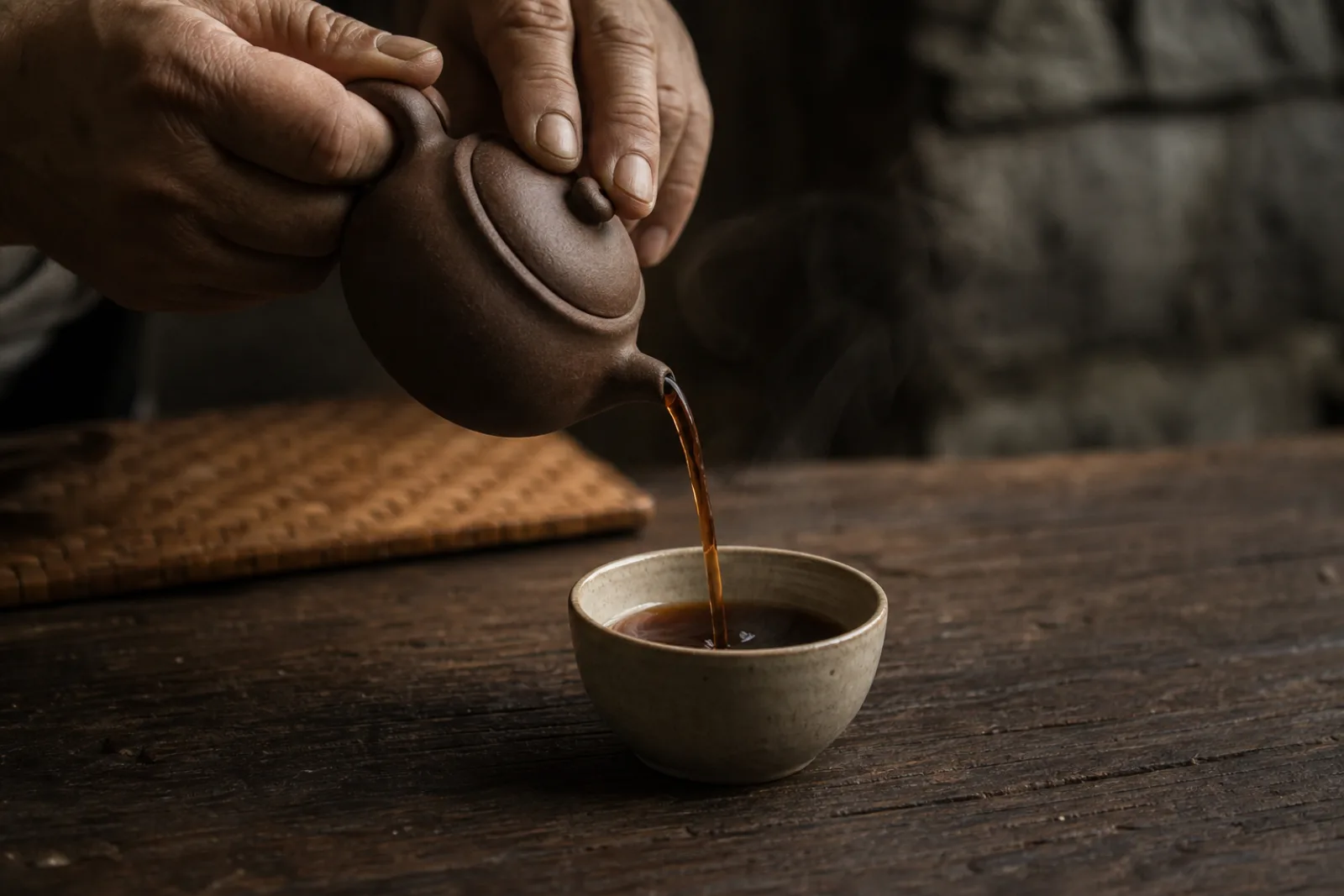
In the cup, his preferences run dry and structural. He likes a sheng that holds its shape across ten infusions without collapsing into sweetness, and a shu with no pond-bottom note — clean fermentation, woody rather than muddy. He brews gōng fū style in a small zǐ shā (紫砂) pot from Yixing for sheng, and in a thicker, wider pot for shu, and he will tell you why if you ask.
Clients who book him through tea.taxi tend to come back. The Same-day sample pack is often a first contact — someone curious, working from a flat in Moscow or Saint Petersburg, who wants to taste four or five things without committing to a full cake. From there, conversations move to the Gift delivery service, or to longer consultations through tea.school and the aged-tea community at puerh.app, where Amgalan contributes tasting notes under his own name. For travel into Yunnan itself, he refers people on to tea.travel rather than running tours himself — his work, he says, is the cup in front of you, not the road there.
2 sessions run by Amgalan
Book a session
Same-day sample pack
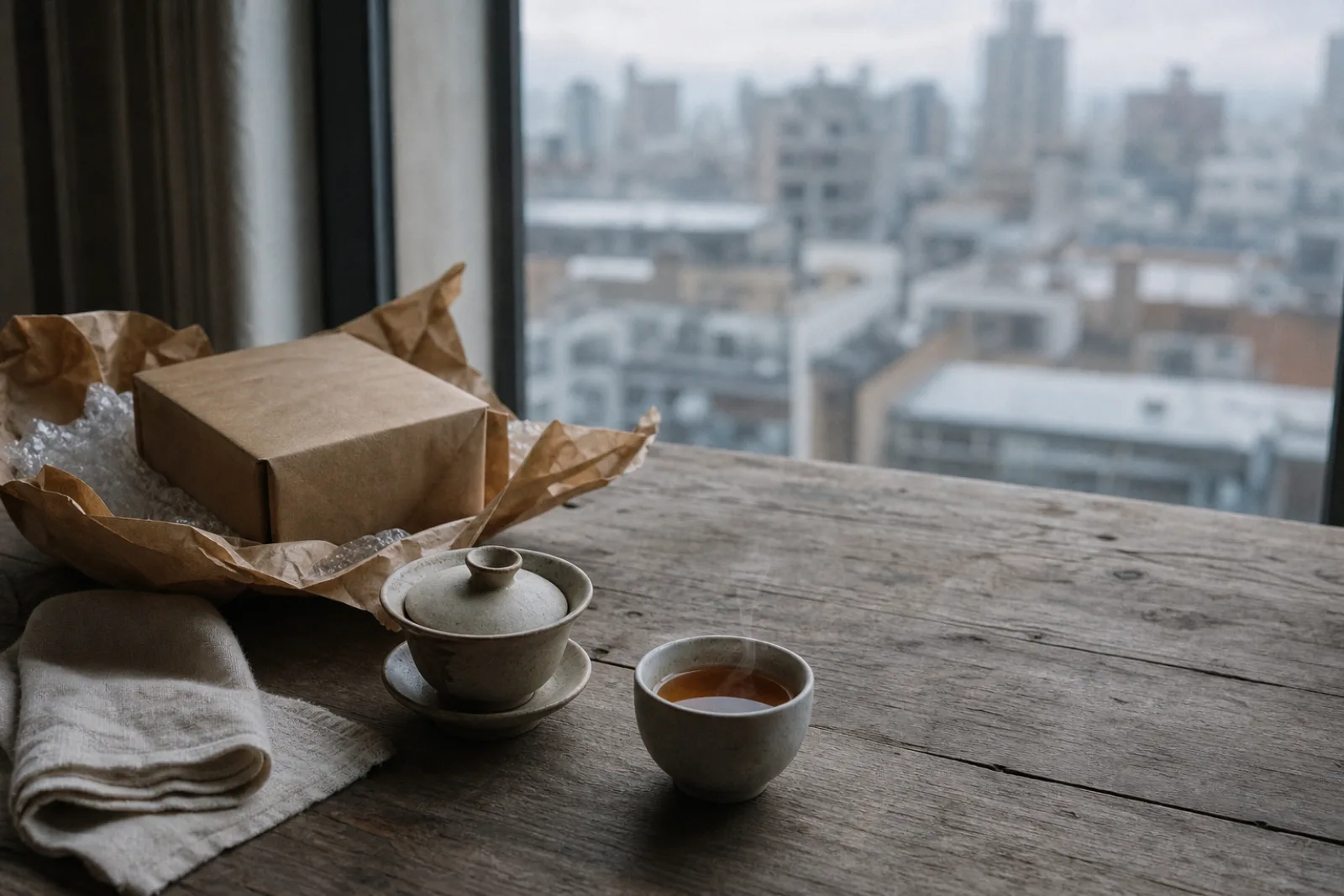
Four 8g sachets of Chinese tea — curated to your brief, sealed the morning of dispatch, and at your door inside two hours across Berlin, Saint Petersburg and London zone 1-2.
from €42 + courier
Gift delivery with hand-written card
A gift-wrapped Chinese tea cake or curated sample pack, delivered the same day in zone, with a card hand-written in the recipient's language by the curator who chose the tea.
from €58 + courier